Maya Tran
April 26, 2026
•
2 min
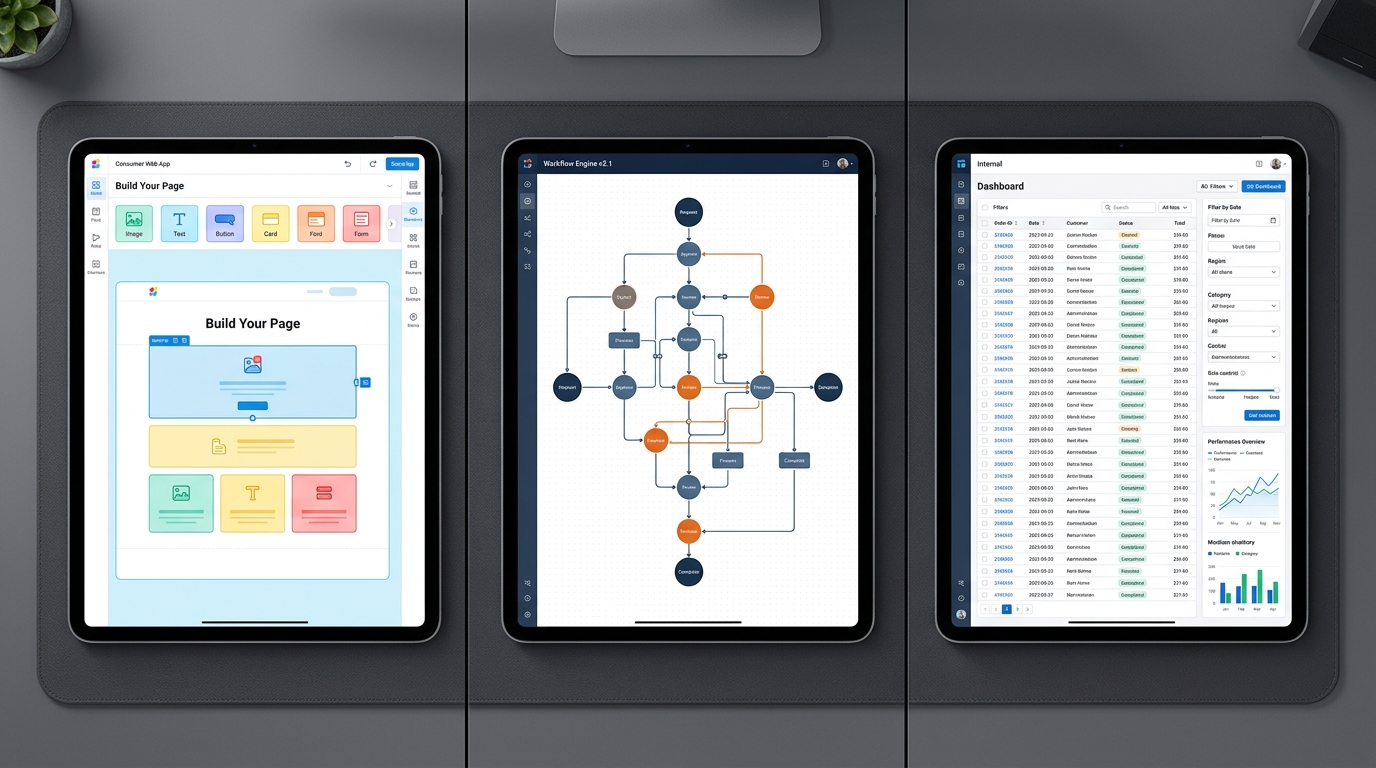
At some point every engineering team faces the same decision: build a custom internal tool from scratch, or grab a platform and ship faster. The problem is the platform landscape is noisy. Bubble, OutSystems, and Retool all claim to solve the same problem, but they're built for completely different jobs. Picking the wrong one costs you months and credibility.
This post breaks down exactly how these three platforms compare on architecture, use case fit, scalability, and total cost of ownership. If you're a founder evaluating your internal ops stack, or an engineer who's been handed a vague "just use no-code" directive, here's what you actually need to know before committing.
These platforms aren't competing products. They solve different problems for different buyers, and conflating them is where most teams go wrong.
Bubble is a consumer app builder. It's designed for founders who want to launch a product—a marketplace, SaaS MVP, or client-facing web app—without writing code. Its data model, workflows, and UI components are all tightly coupled. That's great for speed at the start, and a serious constraint the moment you need to break out of its patterns.
OutSystems is an enterprise application platform aimed at large IT departments. It handles complex business process apps with role-based access, compliance requirements, and integration into legacy systems. The pitch is accelerating enterprise dev cycles. The reality is a heavyweight tool with a steep learning curve, proprietary architecture, and pricing that reflects its target customer: the Fortune 500.
Retool is built specifically for internal tools. Admin panels, operations dashboards, approval workflows, data pipelines with manual override steps—Retool is optimised for exactly this. It connects directly to your existing databases and APIs, puts SQL front and center, and stays out of your way when you need custom logic. It assumes you have engineers. It's built to make those engineers faster, not to replace them.

Bubble's editor is visual-first and approachable for non-developers. But the moment you need something it doesn't support natively—a custom API auth flow, a complex data transformation, a component that doesn't exist in its marketplace—you hit a wall. Custom code is bolted on, not native. You end up contorting your logic to fit Bubble's mental model rather than building what you actually need.
OutSystems gives developers more control through its Service Studio IDE, but "more control" here means "more OutSystems." The abstraction layer is deep. You're learning OutSystems' way of doing everything: data models, integrations, UI patterns. Experienced engineers often find it slower than building with a standard stack, because the proprietary toolchain adds friction at every step.
Retool sits in a different category entirely. You write real SQL directly against your database. You call real REST or GraphQL APIs. Custom JavaScript runs natively in components and queries. If you need something Retool doesn't have out of the box, you write a custom component in React. The ceiling is high because the floor is already close to what your engineers know. A senior engineer familiar with SQL and JavaScript can be productive in Retool within an afternoon.
Bubble apps are hosted on Bubble's infrastructure. You don't control the runtime, and you're sharing resources with every other app on the platform. Performance under load is unpredictable, and compliance-heavy environments—HIPAA, SOC 2, GDPR with specific data residency requirements—are a hard no unless you're on the most expensive tier, where you still have limited infrastructure access.
OutSystems is enterprise-ready by design. It supports on-premise deployment, private cloud, and has certifications for most compliance frameworks. It's the right call if your IT department has a mandate to run everything inside the corporate perimeter and has the budget and headcount to operate it.
Retool offers both cloud and self-hosted deployment, with enterprise SSO, audit logs, granular permissions, and environment-based access controls. Because Retool connects to your existing infrastructure rather than storing your data itself, your data never lives in Retool—it stays in your Postgres instance, your S3 bucket, your API. For most engineering teams building internal tools, that architecture is both simpler and more secure than alternatives that want to own the data layer.
Bubble's entry pricing looks cheap. But the cost picture changes fast once you're past the free tier. As your app grows in complexity and user count, you're paying more for a platform with a ceiling you're likely to hit. Factor in the cost of fighting that ceiling—workarounds, plugin purchases, or eventually migrating off—and the cheap start gets expensive.
OutSystems pricing is opaque and enterprise-negotiated, but publicly available estimates put it in the range of tens of thousands to hundreds of thousands of dollars annually. The platform also carries significant implementation and training costs. If your team isn't already skilled in OutSystems, plan for months of ramp-up. The total cost of ownership is high, and it's designed for organisations where that's acceptable given the scale and compliance requirements involved.
Retool charges per user per month, with a free tier that's actually usable for small teams. The important TCO distinction: Retool compresses the engineering time required to build and maintain internal tools. A dashboard that would take a developer a week to build from scratch takes a day in Retool. That's not a marketing claim—it's the ROI most teams see in practice. The platform cost is almost always less than the engineering hours it saves.
Use Bubble if you're a non-technical founder validating a consumer-facing product idea and you need to move fast without any engineering resources. Accept that you'll likely migrate off it once the product proves out and you hire engineers.
Use OutSystems if you're in a large enterprise IT context, you have compliance requirements that demand on-prem deployment, and you have dedicated budget, licensing negotiation capacity, and a team you're willing to train on a proprietary platform long-term.
Use Retool if you have engineers and you need internal tools built fast on top of your existing data infrastructure. Operations dashboards, customer support panels, approval queues, data management interfaces—Retool is purpose-built for exactly this. It works with the stack you already have rather than asking you to adopt a new one.
The mistake most teams make is evaluating these platforms against each other on a generic feature checklist. The real question is: what are you actually building, and who's building it?
Bubble is for product prototyping without engineers. OutSystems is for enterprise IT programmes with serious budgets and compliance constraints. Retool is for engineering teams who want to ship internal tooling fast without sacrificing control over their data layer or getting locked into a proprietary runtime.
If you're reading this post, you're probably an engineer or a technical founder. That means Retool is almost certainly the right tool for your internal ops stack—not because it wins on every dimension, but because it's the one built for how you actually work.
Looking to supercharge your operations? We’re masters in Retool and experts at building internal tools, dashboards, admin panels, and portals that scale with your business. Let’s turn your ideas into powerful tools that drive real impact.
Curious how we’ve done it for others? Explore our Use Cases to see real-world examples, or check out Our Work to discover how we’ve helped teams like yours streamline operations and unlock growth.
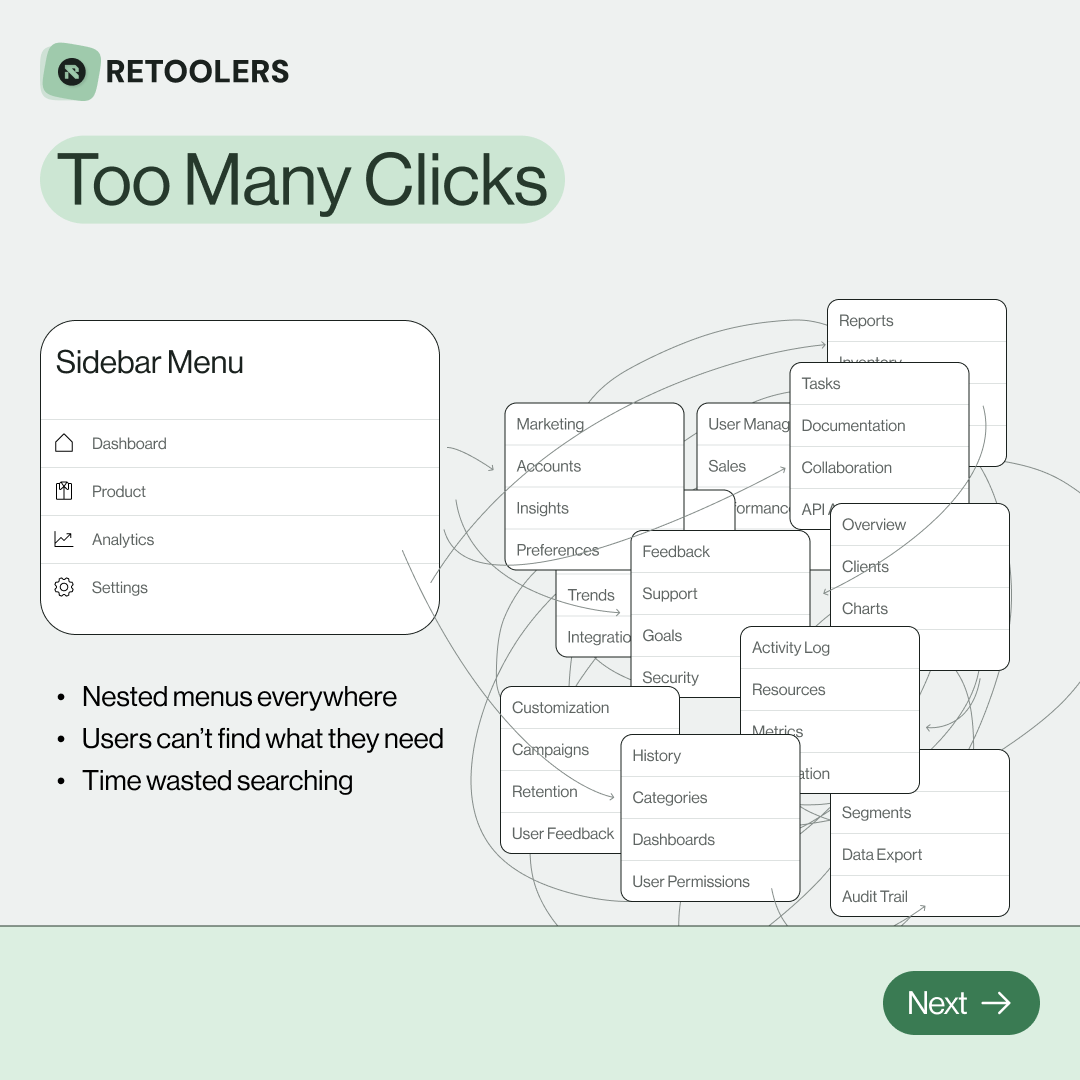
🔎 Internal tools often fail because of one simple thing: Navigation.
Too many clicks, buried menus, lost users.
We broke it down in this 4-slide carousel:
1️⃣ The problem (too many clicks)
2️⃣ The fix (clear navigation structure)
3️⃣ The Retool advantage (drag-and-drop layouts)
4️⃣ The impact (happier teams)
💡 With Retool, you can design internal tools that are easy to use, fast to build, and simple to maintain.
👉 Swipe through the carousel and see how better UX = better productivity.
📞 Ready to streamline your tools? Book a call with us at Retoolers.
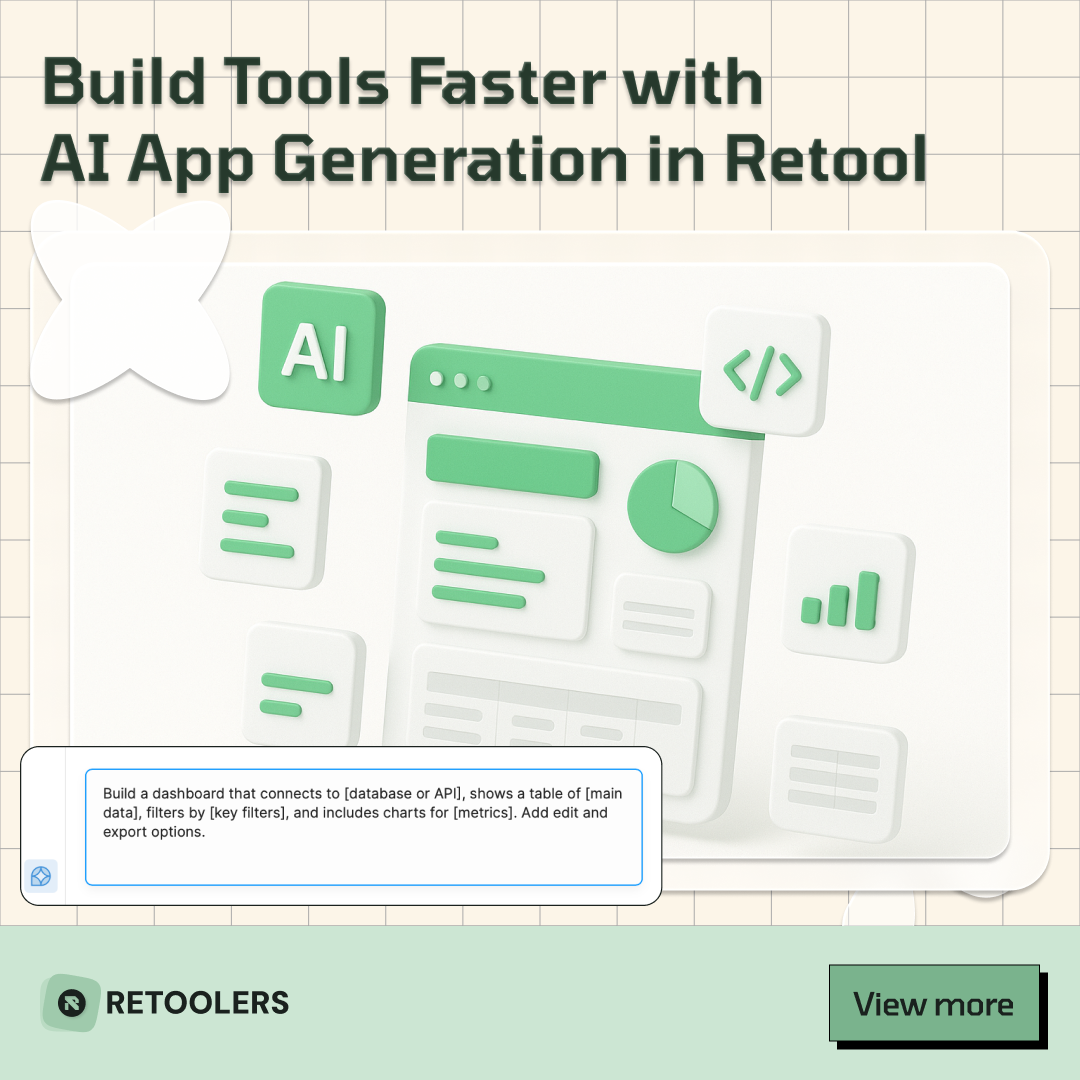
🚀From idea → app in minutesBuilding internal tools used to take weeks.
Now, with AI App Generation in Retool, you can describe what you want in plain English and let AI do the heavy lifting.
At Retoolers, we help teams move faster by combining AI + Retool to create tools that actually fit their workflows.
👉 Check out our blog for the full breakdown: https://lnkd.in/gMAiqy9F
Before we quote, we help you clarify the workflow. Share your idea, process, or existing tools, and we’ll map the key requirements, suggest the right system, and create a free wireframe so you can see the solution before development starts.