Duy Vu
February 10, 2026
•
10 mins read

If you are researching Retool, you are probably not asking whether it works. You are asking how fast it works. Most people searching for retool mvp timeline or build mvp with retool are already comparing it against custom development or other low code tools. The short answer is that Retool is fast because it removes entire layers of traditional product development. You are not building UI frameworks from scratch, not rewriting data access logic, and not waiting weeks for deployments. Instead, you are assembling real internal tools directly on top of live systems. This makes Retool one of the fastest ways to go from idea to working MVP for internal software.
Retool moves quickly because it flips the usual product development flow. Instead of starting with static design files, it starts with live data connections. Once databases and APIs are connected, components like tables, forms, and charts immediately become functional. There is no need to build state management, API clients, or admin layouts manually. This removes weeks of setup work that normally slows MVP delivery.
Another reason Retool accelerates MVP timelines is its component library. Tables, filters, modals, charts, and forms are already production ready. Teams are not reinventing common internal patterns like CRUD workflows or approval flows. This allows developers and operators to focus on business logic rather than infrastructure plumbing.
When people ask how fast is Retool, the honest answer depends on data complexity. Simple read only dashboards can be built extremely quickly, sometimes within days. Tools that involve multiple write operations, chained APIs, or strict permissions naturally take longer. Retool does not eliminate complexity, but it makes it visible earlier, which helps teams scope realistically.
Role based access control is often the biggest factor in timeline variance. Apps with one user type move faster than apps that must carefully separate access between teams. While permissions take time to design and test, they also prevent costly mistakes later. This is time well spent, especially for finance or operations tools.
For most internal tools, the Retool MVP timeline follows a predictable pattern. Discovery and data mapping usually take a few days, especially if APIs are well documented. Layout and live prototyping often happen in parallel and can be completed within a week. Logic, workflows, and validation usually take another one to two weeks depending on complexity. QA and permission testing typically add several days. In total, most Retool MVPs land in the two to four week range, compared to several months for custom builds.
An operations dashboard that pulls inventory, order status, and fulfillment data can often be built in under two weeks. Once the APIs are connected, tables and filters provide immediate value. Iteration happens quickly because stakeholders can test with real data from day one.
Support tools that include ticket triage, customer lookup, and action buttons usually take slightly longer due to permission logic. Finance tools may require additional validation and auditing steps. Even so, these tools are commonly delivered in weeks rather than quarters.
One mistake teams make is treating Retool MVPs as temporary tools. In practice, Retool apps often become long term systems. This is why architecture, permissions, and data integrity still matter. A good MVP focuses on the smallest useful workflow, not the smallest possible build.
Retool shines when feedback loops are short. Instead of guessing what users need, teams ship early versions, observe real usage, and adjust quickly. Because changes do not require full redeploy cycles, iteration feels closer to configuration than development.
If your goal is to build an internal MVP quickly without sacrificing reliability, Retool is one of the strongest options available. For teams asking how fast is Retool, the answer is usually measured in weeks, not months. For founders and operators searching build mvp with retool, the biggest advantage is not just speed but momentum. You get working software early, real feedback fast, and a tool that can grow with your organization instead of being thrown away.
If you want to validate an internal product idea or unblock operations without waiting on a full engineering roadmap, Retool is built for exactly that moment. Get a Quote
Looking to supercharge your operations? We’re masters in Retool and experts at building internal tools, dashboards, admin panels, and portals that scale with your business. Let’s turn your ideas into powerful tools that drive real impact.
Curious how we’ve done it for others? Explore our Use Cases to see real-world examples, or check out Our Work to discover how we’ve helped teams like yours streamline operations and unlock growth.
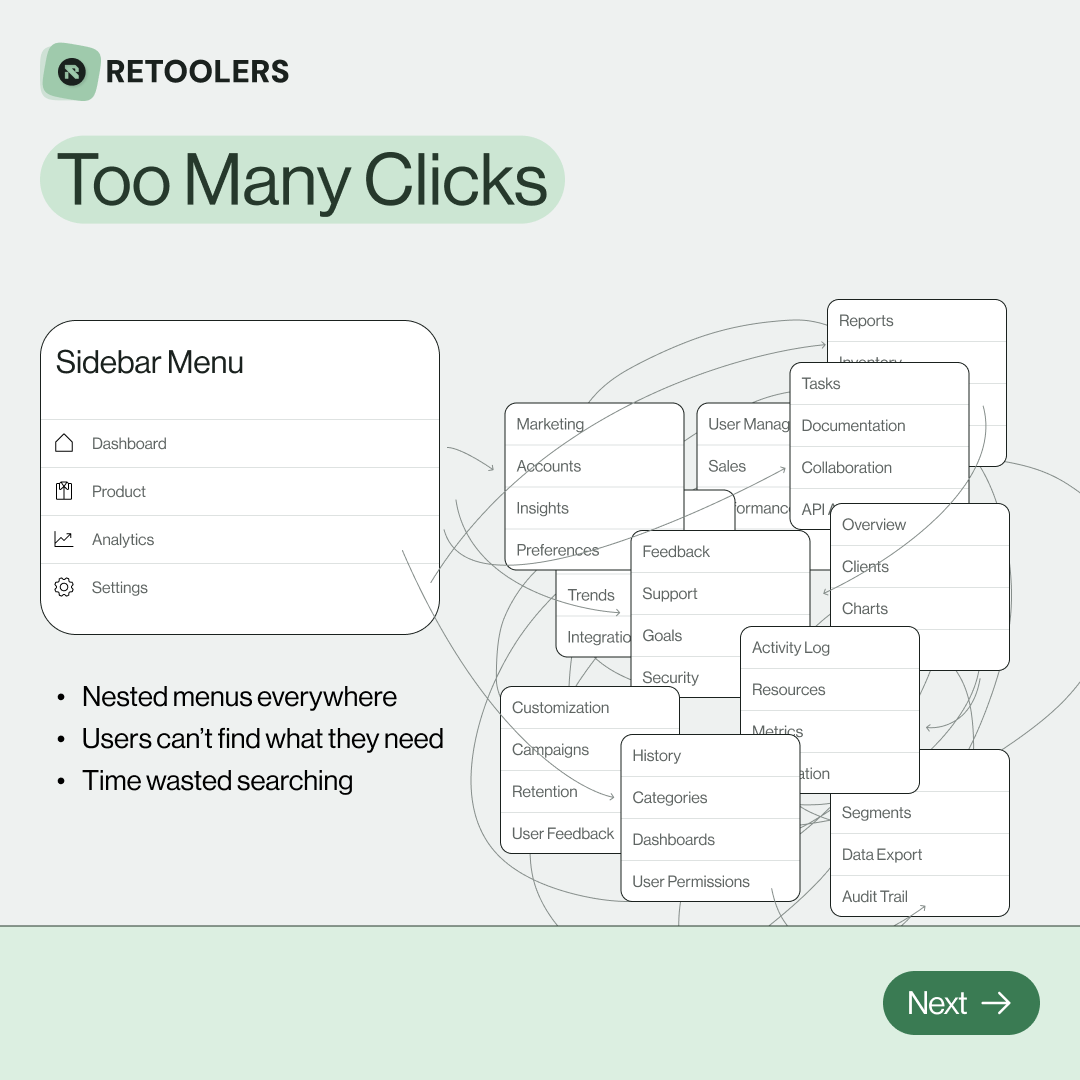
🔎 Internal tools often fail because of one simple thing: Navigation.
Too many clicks, buried menus, lost users.
We broke it down in this 4-slide carousel:
1️⃣ The problem (too many clicks)
2️⃣ The fix (clear navigation structure)
3️⃣ The Retool advantage (drag-and-drop layouts)
4️⃣ The impact (happier teams)
💡 With Retool, you can design internal tools that are easy to use, fast to build, and simple to maintain.
👉 Swipe through the carousel and see how better UX = better productivity.
📞 Ready to streamline your tools? Book a call with us at Retoolers.

🚀From idea → app in minutesBuilding internal tools used to take weeks.
Now, with AI App Generation in Retool, you can describe what you want in plain English and let AI do the heavy lifting.
At Retoolers, we help teams move faster by combining AI + Retool to create tools that actually fit their workflows.
👉 Check out our blog for the full breakdown: https://lnkd.in/gMAiqy9F
Before we quote, we help you clarify the workflow. Share your idea, process, or existing tools, and we’ll map the key requirements, suggest the right system, and create a free wireframe so you can see the solution before development starts.