Duy Vu
February 10, 2026
•
10 mins read

Internal tools often sit in an uncomfortable middle ground inside organizations. They are critical to daily operations, yet they rarely receive the same care as customer facing products. Many teams either rush internal tools to meet urgent operational needs, resulting in fragile apps that break under pressure, or they attempt to build them using full custom front end stacks, which slows delivery and pulls engineering resources away from revenue generating work. The Retool Delivery Process exists to solve this exact problem. It is a purpose built software delivery lifecycle designed specifically for internal tools, combining the speed of low code with the discipline and architectural rigor of traditional engineering. Instead of treating internal tools as shortcuts or side projects, this process treats them as first class systems that deserve structure, security, and scalability without the overhead of a full custom build.
Unlike traditional product development where design mockups often lead the process, Retool delivery starts with infrastructure and data. Because Retool acts as a live interface on top of existing systems, understanding where data lives and how it moves is more important than deciding where buttons go. The discovery phase begins with a deep audit of the technical stack, identifying every database, API, and service the tool will touch. This includes SQL databases, REST endpoints, GraphQL services, and authentication providers that define access boundaries.
Beyond identifying data sources, this phase focuses on mapping user actions to technical reality. The team defines what users actually need to do, whether that is reading records, writing updates, triggering workflows, or coordinating actions across multiple systems. At the same time, constraints are surfaced early, such as API rate limits, network restrictions, VPN requirements, or security rules that influence how Retool must connect to the stack. The goal of this phase is alignment between business expectations and system capabilities, ensuring the tool is designed around what the architecture can safely and reliably support rather than abstract feature requests.
Static design tools are often inefficient for internal applications because they cannot accurately represent real data behavior, edge cases, or operational complexity. Instead of spending weeks refining mockups, the Retool process moves directly into high fidelity wireframing inside the tool itself. Real Retool components such as tables, forms, charts, and filters are placed on the canvas to establish layout and flow using the same building blocks that will exist in production.
This approach allows stakeholders to interact with a working interface almost immediately. Even before logic is fully wired, users can click through screens, test navigation patterns, and provide feedback based on real interaction rather than imagination. Changes to layout or flow can be made in minutes, reducing friction and preventing misunderstandings that often surface late in traditional development cycles.
While Retool simplifies UI assembly, the core of the application is still driven by engineering decisions. During the build phase, technical leads focus heavily on the logic layer, where queries, transformations, and workflows are defined. Optimized SQL and API queries ensure performance remains fast and predictable, avoiding common pitfalls such as over fetching data or executing unnecessary calls.
State management is treated as a first class concern, using Retool storage and temporary state variables to preserve user context across tabs and workflows. When native components are not sufficient, the process allows for controlled customization through JavaScript, CSS, or custom React components, ensuring the tool adapts to the workflow rather than forcing teams to adapt to the tool.
Quality assurance for internal tools is less about visual bugs and more about correctness, safety, and access control. Functional testing verifies that every action triggers the correct backend behavior and that errors are handled gracefully rather than exposing raw system responses. Edge cases are intentionally tested to ensure the app behaves predictably under unexpected conditions.
Permission testing is a critical part of this phase. Role based access control is validated across all user groups to ensure each role can only see and perform actions appropriate to their responsibilities. This prevents accidental data exposure and builds trust in the tool as a safe operational system rather than a risky shortcut.
The first release of a Retool app is treated as a true minimum viable product, but with a higher baseline of quality than most internal tools. It is stable, usable, and secure from day one, allowing a small group of power users to adopt it immediately and provide real world feedback.
Because Retool removes long build and deploy cycles, feedback can be implemented rapidly. New filters, exports, logic changes, or workflow improvements can often be shipped within hours rather than weeks. As adoption grows, performance monitoring and scaling considerations ensure the app continues to perform reliably as usage expands across teams and departments.
By following a structured delivery process tailored specifically for internal tools, teams dramatically reduce time to value while maintaining high standards for security, performance, and usability. Instead of choosing between speed and quality, the Retool Delivery Process delivers both. The result is internal software that is not only built faster, but trusted, adopted, and relied on daily, turning internal tooling from a cost center into a strategic advantage.
If your team is struggling to manage complex data sources or needs a professional release pipeline for your Retool apps, that’s exactly where we come in. At Retoolers, we don't just build apps; we build the infrastructure that keeps your business running. Get a Quote
Looking to supercharge your operations? We’re masters in Retool and experts at building internal tools, dashboards, admin panels, and portals that scale with your business. Let’s turn your ideas into powerful tools that drive real impact.
Curious how we’ve done it for others? Explore our Use Cases to see real-world examples, or check out Our Work to discover how we’ve helped teams like yours streamline operations and unlock growth.
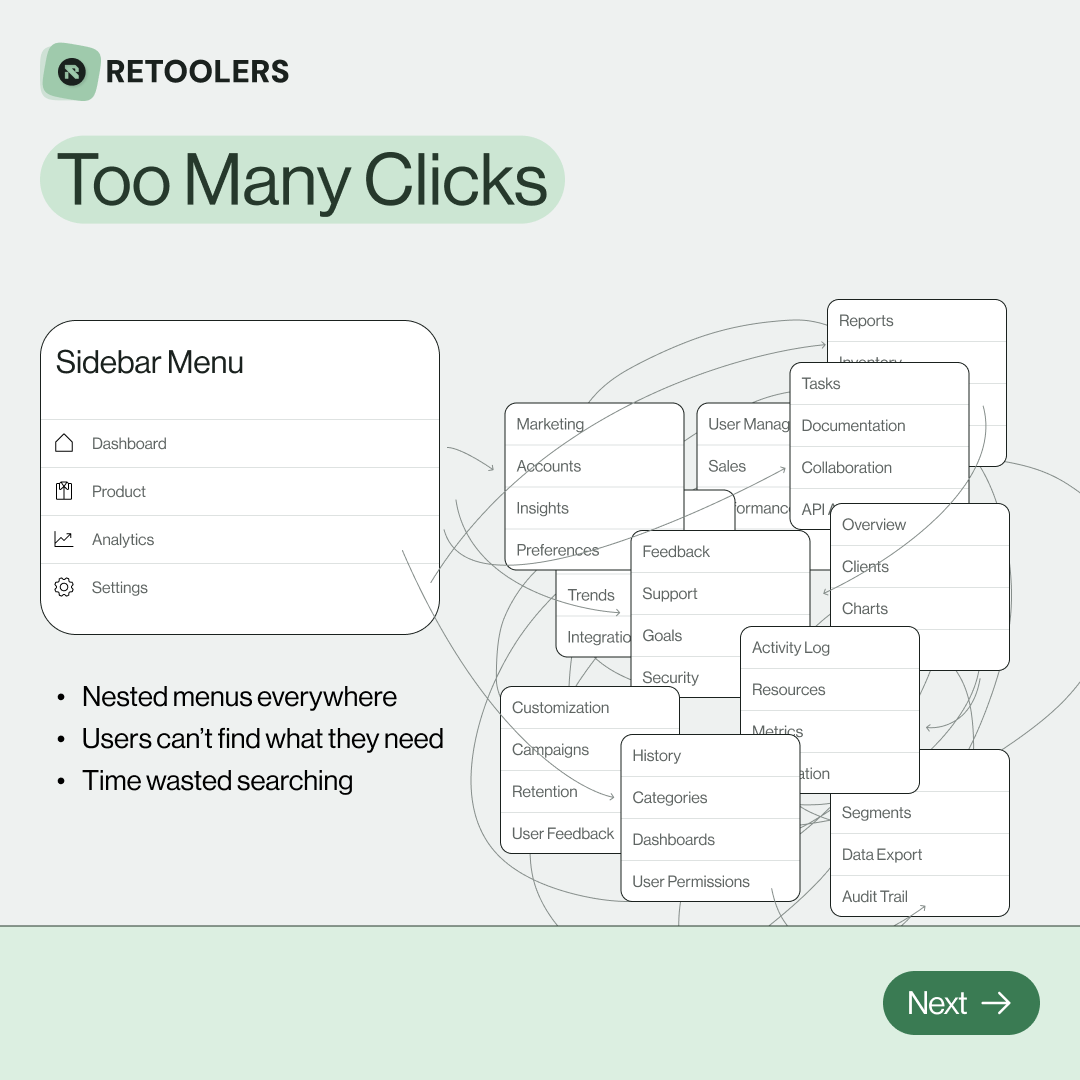
🔎 Internal tools often fail because of one simple thing: Navigation.
Too many clicks, buried menus, lost users.
We broke it down in this 4-slide carousel:
1️⃣ The problem (too many clicks)
2️⃣ The fix (clear navigation structure)
3️⃣ The Retool advantage (drag-and-drop layouts)
4️⃣ The impact (happier teams)
💡 With Retool, you can design internal tools that are easy to use, fast to build, and simple to maintain.
👉 Swipe through the carousel and see how better UX = better productivity.
📞 Ready to streamline your tools? Book a call with us at Retoolers.

🚀From idea → app in minutesBuilding internal tools used to take weeks.
Now, with AI App Generation in Retool, you can describe what you want in plain English and let AI do the heavy lifting.
At Retoolers, we help teams move faster by combining AI + Retool to create tools that actually fit their workflows.
👉 Check out our blog for the full breakdown: https://lnkd.in/gMAiqy9F
Before we quote, we help you clarify the workflow. Share your idea, process, or existing tools, and we’ll map the key requirements, suggest the right system, and create a free wireframe so you can see the solution before development starts.