Duy Vu
February 9, 2026
•
10 mins read

When teams adopt Retool, the conversation quickly moves beyond how fast you can build dashboards. Security, compliance, and long term ownership become real concerns, especially for companies building mission critical internal tools. One of the most common questions we hear is simple but important. Who actually owns the Retool app, the JSON configuration, and any custom components built on top of it?This article explains exactly how ownership works in Retool, how it differs between cloud and self hosted deployments, and what that means for your business long term.
A Retool app is not just a visual dashboard. Behind the scenes, every app is stored as a structured JSON configuration. This JSON defines the UI layout, components, queries, workflows, permissions, and logic that power the app. Because Retool apps are config driven, ownership of this JSON is effectively ownership of the app itself. Whoever owns the account that stores this JSON owns the application logic, design, and behavior. This is an important distinction because it separates ownership from individual developers. Even if an employee or agency builds the app, the app itself belongs to the account.
All Retool apps are owned at the account level, not by individual users. Users can be granted edit access, view access, or admin permissions, but ownership stays with the account owner. This means your company does not lose control if a developer leaves or if an external agency finishes a contract. As long as the app lives inside your Retool account, you own it. From an IP and compliance perspective, this makes Retool closer to an internal framework rather than a third party app builder that locks you in.
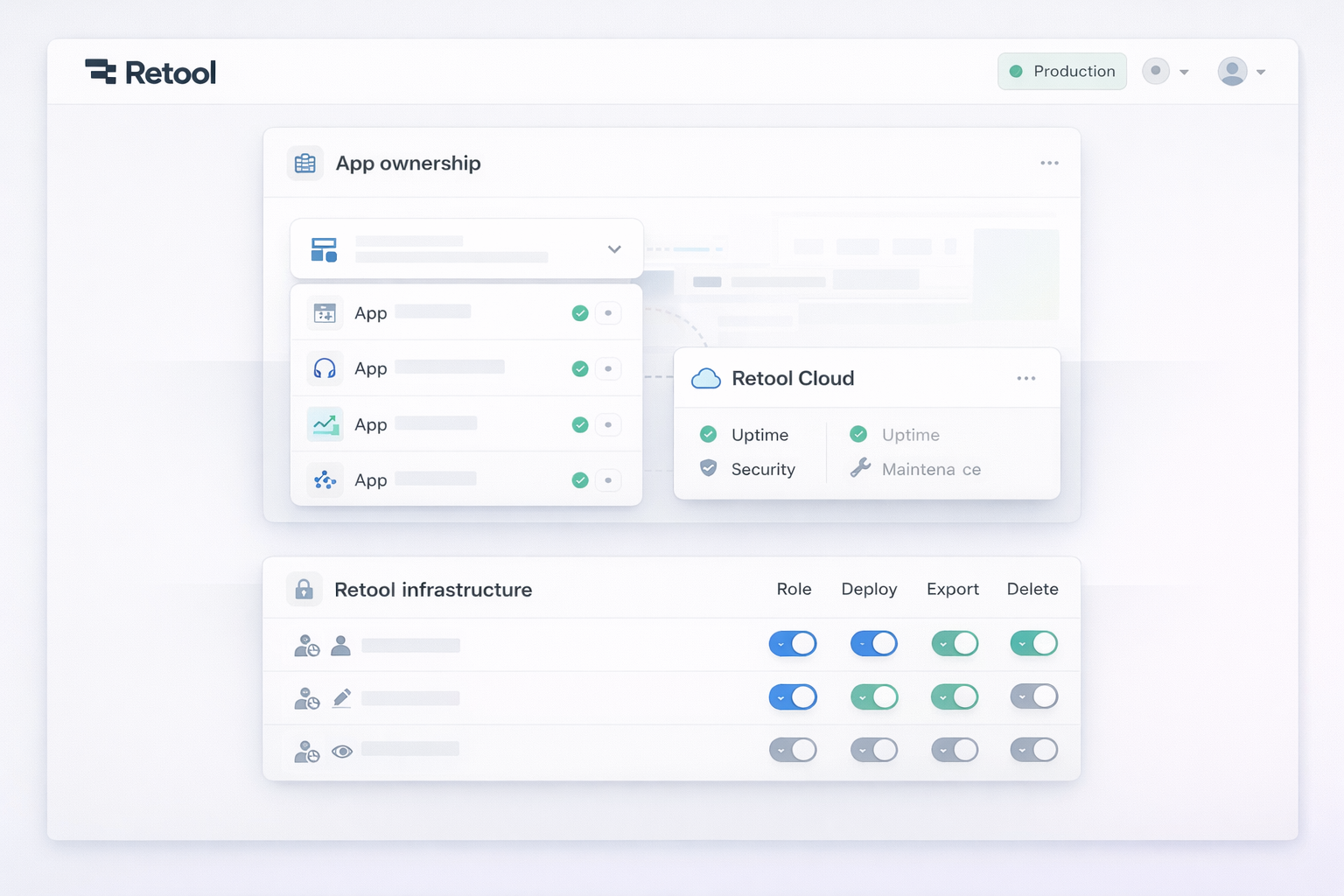
On Retool Cloud, the account owner owns all apps, their JSON configurations, and the business logic inside them. Retool operates the infrastructure, but they do not own your applications. You can think of this like hosting an application on AWS. AWS runs the servers, but they do not own your code. Retool plays a similar role for internal tools.
Retool is technically the super owner of the cloud environment, because they manage uptime, security patches, and infrastructure. However, this does not change ownership of your app logic, workflows, or data access rules. Your organization controls who can edit, deploy, export, or delete apps inside the workspace.
Even on Retool Cloud, your company retains ownership of how data is accessed and used. Retool apps connect to your databases and APIs through resources that you configure. Retool does not take ownership of your data. They provide the platform that executes queries and API calls, but the data source, credentials, and access policies remain under your control. This is especially important for companies dealing with customer data, financial records, or internal metrics.
For companies with strict security or compliance requirements, Retool can be deployed in a self hosted environment. In this model, ownership is even clearer. When Retool is self hosted, the account owner controls everything. The apps, JSON configs, data connections, secrets, and infrastructure all live inside your own environment. Retool has no operational ownership in this setup. They provide the software, but they do not host or access your apps unless explicitly granted. From a governance standpoint, self hosted Retool behaves like any other internal application framework running inside your infrastructure.
All logic written inside a Retool app belongs to the account owner. This includes SQL queries, REST and GraphQL calls, transformers, workflows, event handlers, and permission rules. Even advanced logic such as conditional rendering, role based access, and workflow automation remains part of the app JSON owned by your account. This means you are free to evolve the app over time, refactor logic, or migrate functionality without being locked to a vendor controlled system.
This is another common concern from enterprise teams. If you stop using Retool, do you lose your apps? The app JSON remains yours. While Retool apps are built on the Retool platform and require Retool to run, the configuration and logic are not owned by Retool. This transparency is important when evaluating long term platform risk.
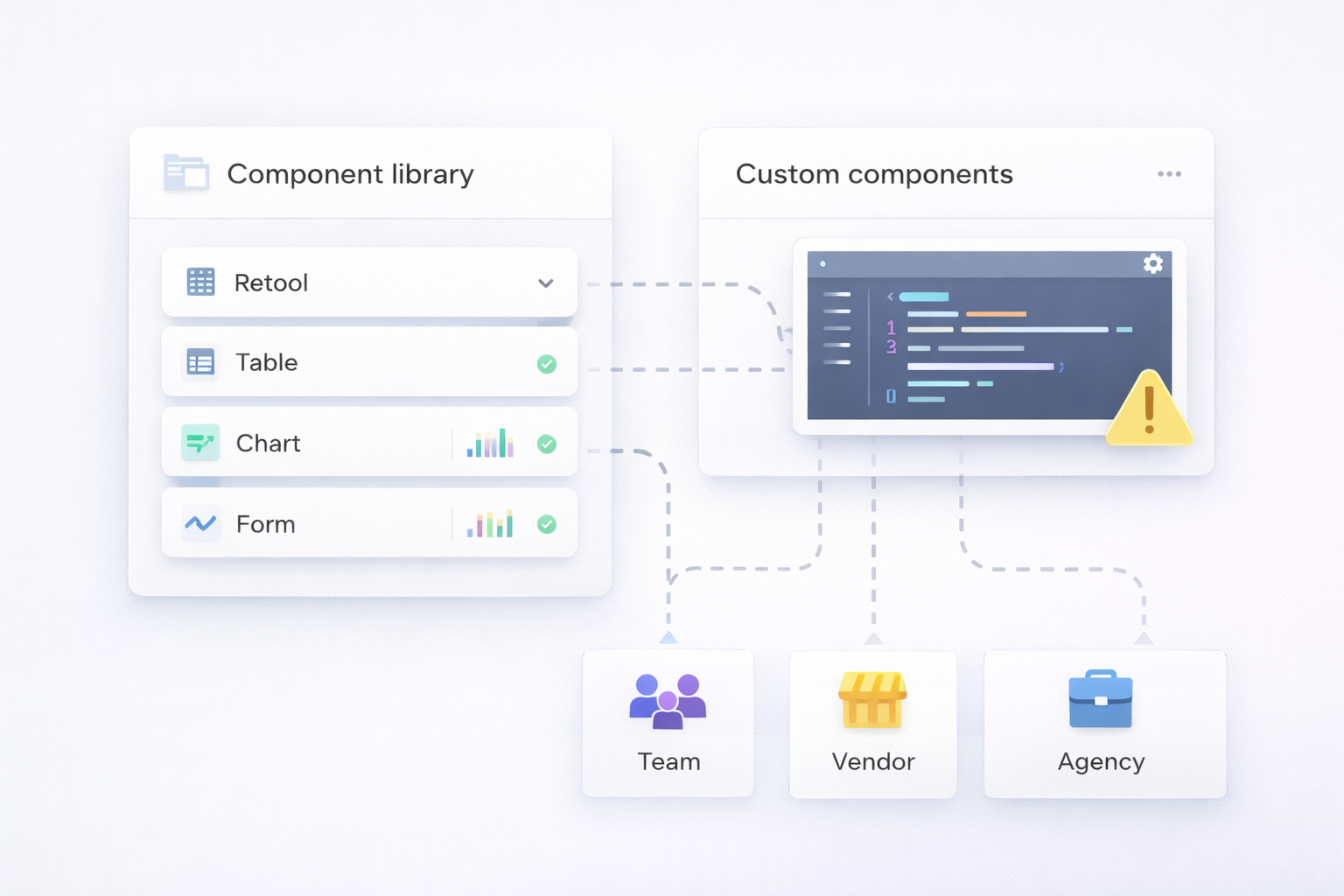
Custom components work differently from standard Retool components. These are advanced extensions built using external code to add functionality not available in the default component library. Ownership of custom components depends on who builds and maintains them. In most cases, custom components are owned by the team, vendor, or agency that created them. Retool does not automatically support or maintain custom components. If a custom component breaks due to platform updates or browser changes, responsibility usually falls on the component owner. For production use cases, it is important to define ownership and maintenance clearly before relying heavily on custom components.
For enterprise teams planning to build or use custom components at scale, it is recommended to reach out directly to Retool. Retool can provide guidance on best practices, long term compatibility, and support expectations. This helps avoid issues where critical functionality depends on unsupported extensions. Many teams also choose to minimize custom components and rely on native Retool features to reduce maintenance risk.
Ownership clarity is not just a legal concern. It affects how confidently teams can build internal tools. When ownership is clear, teams move faster. Security teams know where data lives. Legal teams understand IP boundaries. Engineering teams know they can maintain and evolve tools long term. This clarity is one of the reasons Retool works well for companies building serious internal systems rather than one off dashboards.
Retool apps and their JSON configurations are owned by the account owner, whether you use cloud or self hosted. Retool provides the platform, not the ownership of your logic. Custom components require extra consideration, but with clear ownership and support planning, they can be used safely. For companies evaluating Retool, understanding this ownership model early removes uncertainty and helps teams adopt the platform with confidence.
If your team is struggling to manage complex data sources or needs a professional release pipeline for your Retool apps, that’s exactly where we come in. At Retoolers, we don't just build apps; we build the infrastructure that keeps your business running. Get a Quote
Looking to supercharge your operations? We’re masters in Retool and experts at building internal tools, dashboards, admin panels, and portals that scale with your business. Let’s turn your ideas into powerful tools that drive real impact.
Curious how we’ve done it for others? Explore our Use Cases to see real-world examples, or check out Our Work to discover how we’ve helped teams like yours streamline operations and unlock growth.
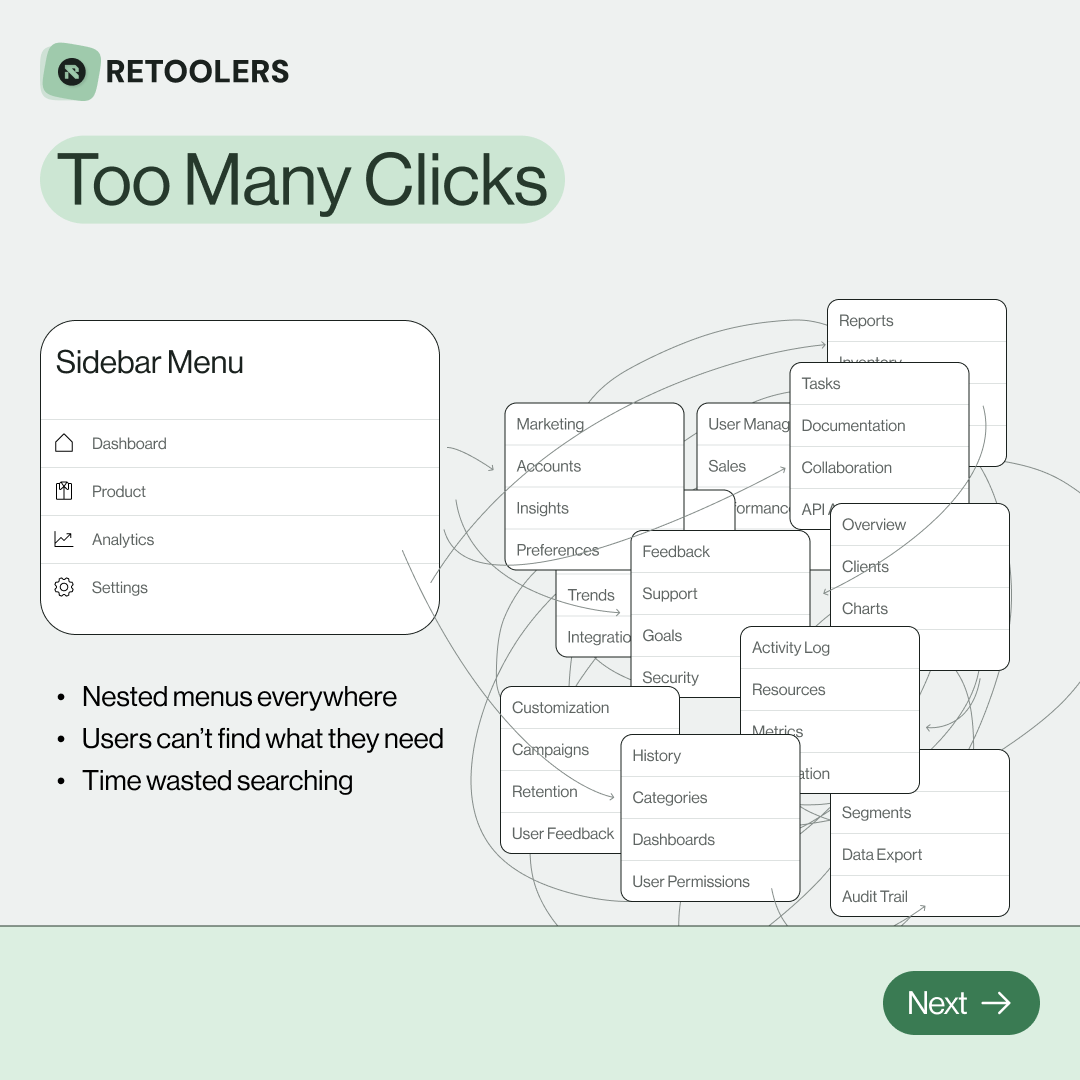
🔎 Internal tools often fail because of one simple thing: Navigation.
Too many clicks, buried menus, lost users.
We broke it down in this 4-slide carousel:
1️⃣ The problem (too many clicks)
2️⃣ The fix (clear navigation structure)
3️⃣ The Retool advantage (drag-and-drop layouts)
4️⃣ The impact (happier teams)
💡 With Retool, you can design internal tools that are easy to use, fast to build, and simple to maintain.
👉 Swipe through the carousel and see how better UX = better productivity.
📞 Ready to streamline your tools? Book a call with us at Retoolers.
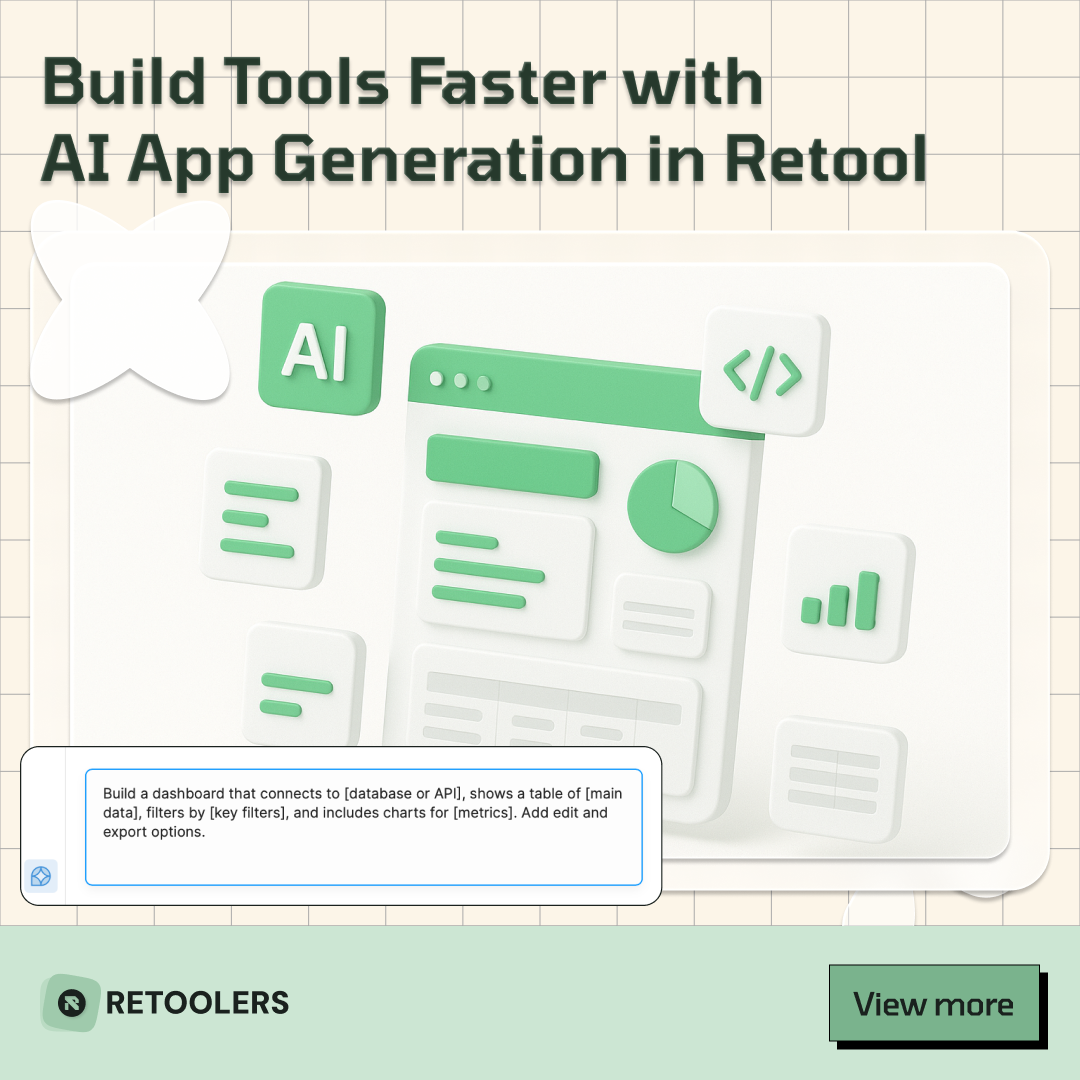
🚀From idea → app in minutesBuilding internal tools used to take weeks.
Now, with AI App Generation in Retool, you can describe what you want in plain English and let AI do the heavy lifting.
At Retoolers, we help teams move faster by combining AI + Retool to create tools that actually fit their workflows.
👉 Check out our blog for the full breakdown: https://lnkd.in/gMAiqy9F
Before we quote, we help you clarify the workflow. Share your idea, process, or existing tools, and we’ll map the key requirements, suggest the right system, and create a free wireframe so you can see the solution before development starts.